

The Convergence of AI, IoT, and 5G: Building Smarter Industries
Intelligent technologies. Seamless connectivity. Limitless possibilities. Explore how AI, IoT, and 5G are powering smarter industries through intelligent automation, real-time connectivity, and faster, data-driven decision-making.
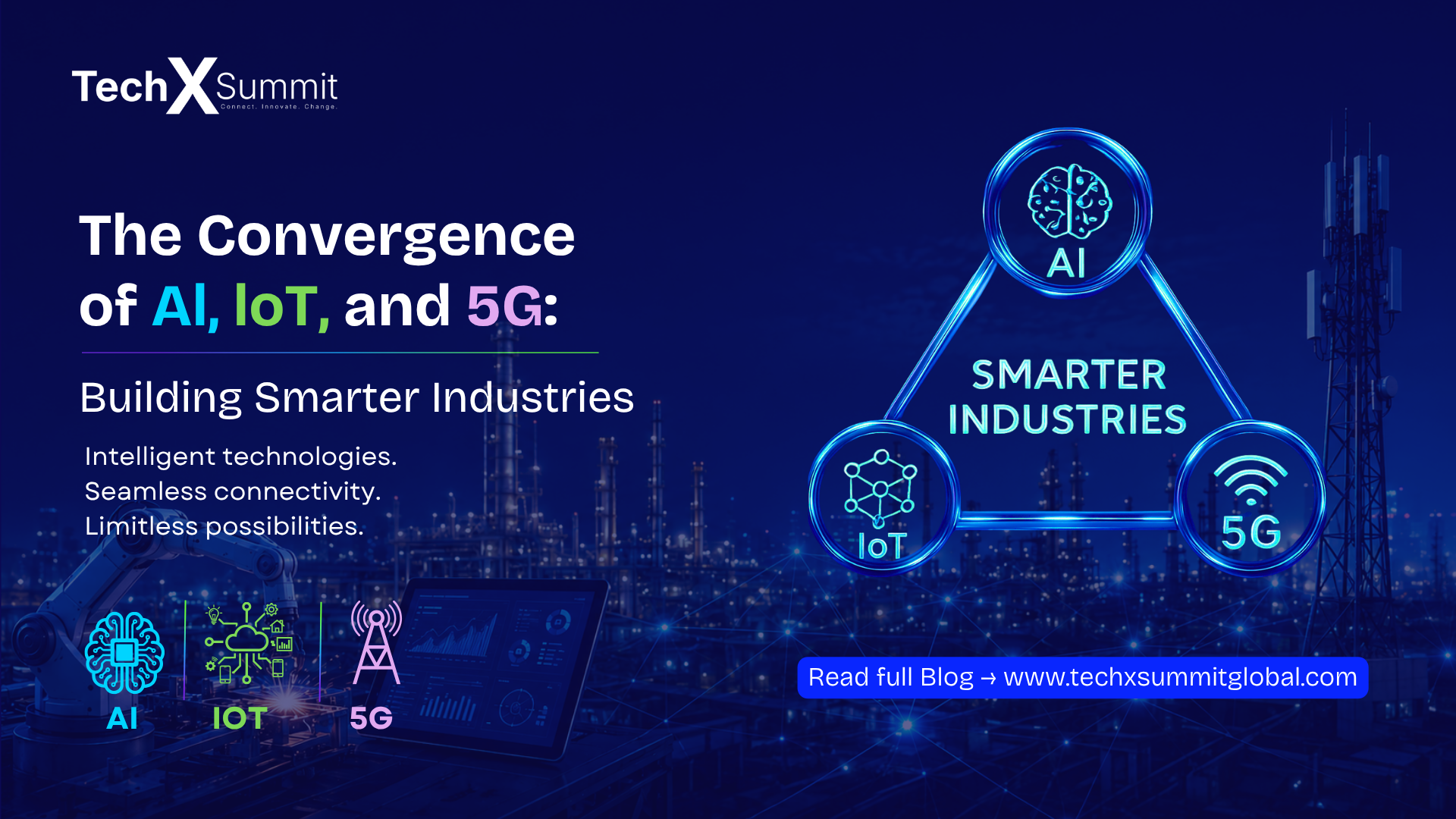
Three technologies are quietly rewriting the rules of modern industry: Artificial Intelligence, the Internet of Things, and 5G connectivity. Individually, each has already reshaped how businesses operate. Together, they form a single intelligent nervous system — one that senses, connects, and thinks in real time. This convergence is what's now driving the next generation of smart factories, smart cities, and smart everything.
What Does AI + IoT + 5G Convergence Actually Mean?
Each technology plays a distinct role. IoT sensors act as the senses of an industrial system, constantly collecting data from machines, vehicles, and environments. 5G acts as the nervous system, moving that data instantly and reliably across vast networks with minimal latency. AI acts as the brain, analyzing the flood of incoming data to detect patterns, predict outcomes, and trigger automated action.
On their own, each technology has limits. IoT devices generate data but can't interpret it. AI needs fast, reliable data pipelines to be useful in real time. 5G needs meaningful data and intelligent endpoints to justify its speed. Combined, they remove each other's bottlenecks and unlock capabilities none could deliver alone.
1. AI: The Brain Behind the System
Artificial intelligence transforms raw sensor data into actionable insight. Machine learning models trained on historical operational data can detect anomalies, forecast equipment failures, and optimize processes far faster than human analysts. In industrial settings, this means catching a failing motor bearing weeks before it breaks, rather than reacting after a costly shutdown.
Edge AI — running inference directly on local devices rather than in a distant data center — is increasingly critical. It allows split-second decisions, such as an autonomous vehicle avoiding an obstacle or a factory robot adjusting its grip, without waiting for a round trip to the cloud.
2. IoT: The Senses of the Smart Enterprise
IoT devices are the eyes, ears, and touch of a connected system. Temperature sensors, vibration monitors, RFID tags, cameras, and GPS trackers continuously capture the physical state of equipment, inventory, and environments. This constant stream of telemetry is the raw material that AI depends on.
The value of IoT scales with density and diversity — the more sensors deployed and the more varied their data types, the richer the picture an AI model can build. But that density also multiplies the volume of data that needs to move quickly and reliably, which is exactly where 5G becomes essential.
3. 5G: The Nervous System Connecting It All
5G networks deliver the low latency, high bandwidth, and massive device density that IoT and AI require to function at scale. Where earlier networks struggled to support thousands of simultaneous connected devices in a single facility, 5G's network slicing and edge computing architecture make it possible to prioritize mission-critical data streams in real time.
This is particularly transformative for latency-sensitive applications: remote surgery, autonomous vehicles, and robotic manufacturing lines all require data to travel and return in milliseconds. 5G is the connective tissue that makes real-time AI-IoT collaboration physically possible at industrial scale.
4. Real-Time Decision-Making at the Edge
Edge computing brings processing power closer to where data is generated, reducing reliance on centralized cloud infrastructure. Combined with 5G's speed and AI's analytical power, edge computing enables systems to sense, decide, and act within the same operational moment — a capability essential for safety-critical and time-sensitive industries.
- Manufacturing: real-time defect detection on the production line
- Logistics: dynamic route optimization based on live traffic and fleet data
- Energy: instant load balancing across smart grids
- Retail: real-time inventory and demand-sensing at the shelf edge
"AI gives industry its intelligence, IoT gives it its senses, and 5G gives it the speed to act on both — together, they turn data into decisions in real time."
— Tech X Summit Editorial Team, 2026
5. Smarter Manufacturing
In smart factories, IoT sensors track everything from vibration signatures to ambient temperature across the production floor. AI models continuously analyze this data to predict maintenance needs, optimize throughput, and flag quality issues before defective products leave the line. 5G ensures this coordination happens across hundreds of machines without lag, turning the factory floor into a self-optimizing system.
6. Smarter Cities
Urban environments are becoming testbeds for this convergence. Traffic management systems use IoT cameras and sensors, AI-driven prediction models, and 5G connectivity to adjust signal timing in real time, easing congestion and reducing emissions. Smart grids balance electricity demand dynamically, while connected public safety systems can detect and respond to incidents faster than ever before.
7. Smarter Healthcare
Remote patient monitoring devices continuously stream vital signs to AI systems that flag early warning signs of deterioration. 5G's ultra-low latency is what makes emerging use cases like remote-assisted surgery and real-time diagnostic imaging transfer viable, extending specialist expertise to locations that previously had none.
Challenges on the Road to Convergence
This convergence is powerful, but not without friction. Interoperability between devices from different vendors remains a persistent challenge. Security is a growing concern as every additional connected sensor becomes a potential attack surface. And the sheer volume of data generated requires thoughtful architecture to avoid overwhelming networks or analytics pipelines with noise instead of signal.
Organizations that succeed treat this as a systems-design problem, not just a technology procurement exercise — building standardized data models, robust security postures, and clear governance around how AI decisions are validated and monitored over time.
Key Takeaways: AI, IoT, and 5G Convergence
- AI is the brain: it turns raw sensor data into predictions and automated decisions
- IoT is the senses: it continuously captures the physical state of machines and environments
- 5G is the nervous system: it moves data fast enough for AI to act in real time
- Edge computing brings sensing, deciding, and acting into the same operational moment
- Manufacturing, smart cities, and healthcare are leading real-world adopters
- Interoperability, security, and data governance are the biggest hurdles to solve
Conclusion
The convergence of AI, IoT, and 5G isn't a distant vision — it's already reshaping factories, cities, and hospitals today. As these three technologies continue to mature together, the organizations that design for their intersection — rather than treating them as separate initiatives — will build the smarter, faster, more responsive industries of tomorrow. Tech X Summit Singapore 2026 brings together the innovators building this connected future. Join us to explore what's next for intelligent, connected industry.
