

Why Prompt Engineering Is Evolving Into AI Workflow Design
From writing better prompts to building intelligent systems — discover how AI is shifting from a question-and-answer tool to an autonomous decision-making layer inside enterprise operations.
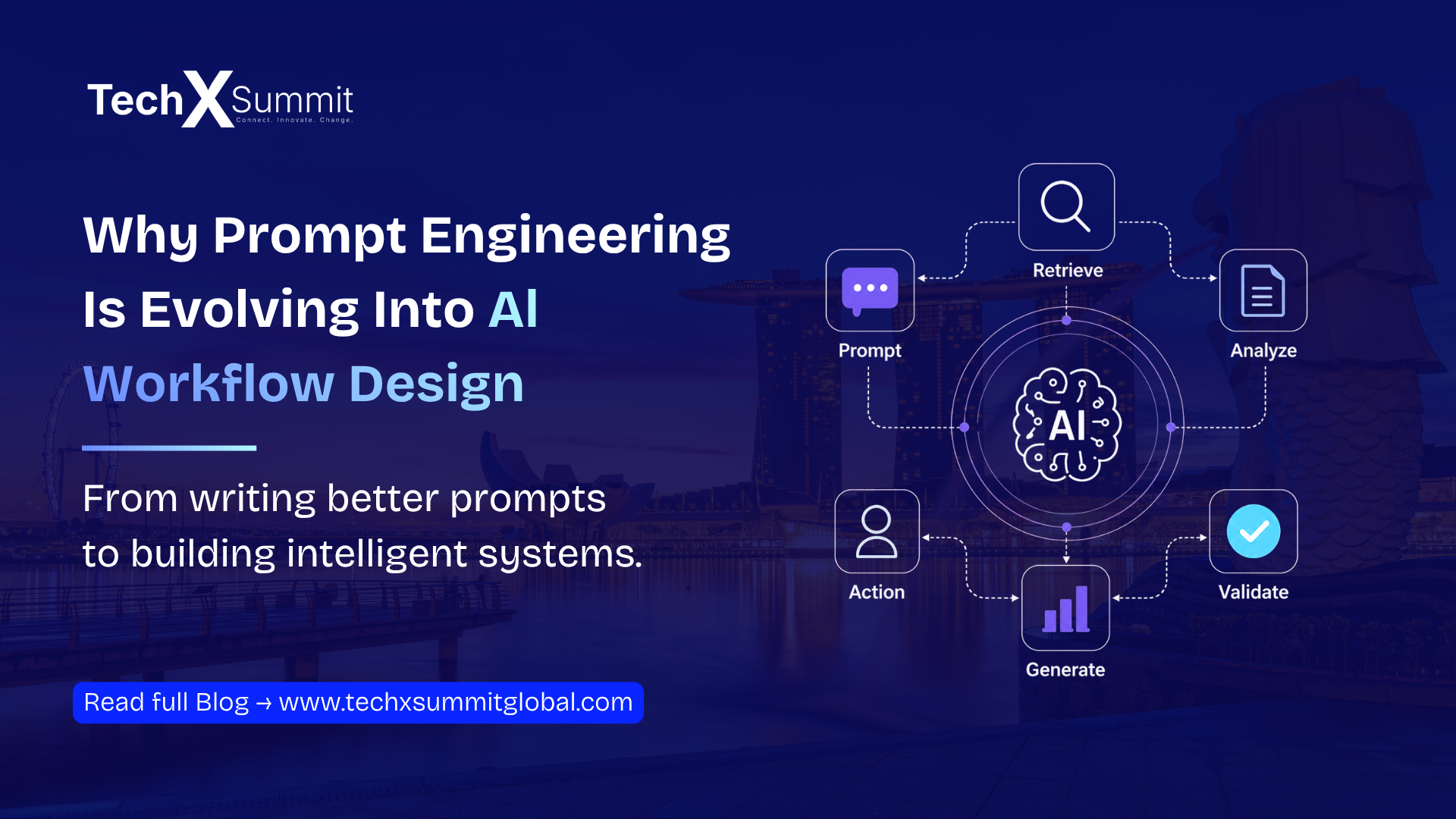
Two years ago, "prompt engineering" was the skill everyone wanted to hire for. The idea was simple: if you knew exactly how to phrase a question, you could get dramatically better results from AI models. Entire job listings appeared overnight, courses sold out, and LinkedIn profiles began listing it as a core competency. Today, that framing is already showing its age — not because prompting doesn't matter, but because the problems enterprises actually need to solve have outgrown what a well-crafted sentence can do on its own.
What's replacing it isn't a new prompting trick. It's a fundamentally different way of thinking about AI — one that treats language models not as sophisticated search engines you query, but as reasoning components inside larger, multi-step automated systems. That shift, from prompt engineering to AI workflow design, is quietly reshaping how forward-thinking organizations build software, run operations, and compete.
What Prompt Engineering Actually Is — and Where It Stops
Prompt engineering is the practice of crafting inputs to a language model in ways that reliably produce useful outputs. At its best, it is a genuine discipline: understanding how a model reasons, where it tends to drift, how to use system instructions to shape its persona, and how few-shot examples shift its behavior. For knowledge workers doing one-off tasks — summarizing a document, drafting a reply, brainstorming options — it remains genuinely valuable.
But prompt engineering has a structural ceiling. A single prompt, however well-designed, cannot retrieve live data, call an external API, check its own output for errors, hand off a subtask to a specialized model, or loop back to try a different approach when something fails. As soon as a task requires any of those capabilities, the prompt itself becomes the smallest part of the problem.
What AI Workflow Design Looks Like Instead
Orchestration: Chaining Models and Tools Together
AI workflow design starts by decomposing a complex task into smaller, well-defined steps — and then building a system that routes each step to the right component. That might mean a language model drafts an initial response, a retrieval system pulls relevant documents, a second model evaluates the draft for accuracy, and a third formats the final output for the target channel. No single prompt handles all of that; an orchestration layer does.
Frameworks like LangChain, LlamaIndex, and the Model Context Protocol (MCP) have emerged specifically to make this kind of multi-step orchestration manageable. They give developers standard abstractions for connecting language models to databases, APIs, code executors, and each other — turning what would have been brittle custom code into composable building blocks.
Agents: Systems That Plan and Adapt
The most consequential version of this shift is the rise of agentic AI — systems that don't just respond to a single input but pursue a goal over multiple steps, deciding as they go which tools to use, what to check, and when to ask for human input. An agent handling a customer support escalation, for example, might autonomously pull the customer's order history, cross-reference a returns policy, draft a resolution, flag it for human review if the refund amount crosses a threshold, and then send the approved response — all without a human touching each step.
This is a qualitatively different relationship between AI and work. The model is no longer answering a question; it is executing a process.
"The bottleneck is no longer writing better prompts. It's designing systems where AI can take reliable, auditable action across real business processes — and knowing which decisions still need a human in the loop."
— Tech X Summit Editorial Analysis, 2026
The New Skills This Demands
The practitioners building these systems look less like copywriters who happen to know AI, and more like systems architects who understand both software engineering and model behavior. The critical skills are shifting accordingly:
- Task decomposition — breaking a high-level goal into discrete, testable subtasks that each have a clear success condition.
- Tool design — building the APIs, retrieval systems, and action endpoints that an agent can call reliably.
- Evaluation and guardrails — designing the checks that catch model errors before they propagate through a workflow, and defining the thresholds that trigger human review.
- Observability — instrumenting a workflow so you can see what the model did at each step, why it made a decision, and where it went wrong.
- Human-in-the-loop design — deciding consciously which decisions should stay with humans, rather than discovering after a failure that they should have.
These are engineering and product design skills as much as they are AI skills. Teams that treat AI workflow design as a pure AI problem, rather than a systems problem, consistently underestimate the difficulty and overestimate what the model alone can handle.
Where This Is Already Playing Out
Software Development
AI coding tools have moved well beyond autocomplete. Systems like Claude Code and similar agents can now accept a high-level task description, plan an implementation approach, write code across multiple files, run tests, interpret the results, and iterate — all within a single workflow. The prompt that starts the process is a small fraction of the overall system behavior.
Knowledge Work and Research
Enterprise deployments for legal review, financial analysis, and competitive intelligence now routinely chain retrieval, summarization, fact-checking, and formatting steps together. A single research request might trigger dozens of model calls across several specialized sub-workflows before producing a final deliverable — none of which is visible to the end user, who simply sees a well-structured answer.
Customer Operations
Contact centers have been among the earliest enterprise adopters of agentic workflows, because the tasks — intent classification, policy lookup, response generation, escalation routing — decompose cleanly into steps that can each be handled by specialized components. The results in early deployments have been significant enough that the architecture is spreading rapidly to adjacent functions like HR, procurement, and IT support.
Key Takeaways: Prompt Engineering → AI Workflow Design
- Prompt engineering remains valuable for one-off tasks, but it has a structural ceiling — it cannot replace orchestration for multi-step, multi-tool processes.
- AI workflow design treats language models as reasoning components inside larger systems, not as standalone question-answering tools.
- Agentic systems that plan, act, and adapt over multiple steps represent the most consequential shift in how AI is applied to enterprise work.
- The new critical skills are task decomposition, tool design, evaluation, observability, and human-in-the-loop architecture — not prompt writing.
- Teams that treat this as a systems problem — not just an AI problem — consistently build more reliable, auditable, and scalable workflows.
Conclusion
Prompt engineering was the right entry point into practical AI for millions of practitioners, and it isn't going away. But the frontier of what enterprises can actually accomplish with AI has moved decisively beyond what any single, well-crafted prompt can deliver. The organizations pulling ahead are the ones that have shifted their mental model — from "how do we ask AI better questions?" to "how do we design systems where AI takes reliable, auditable action on real work?" That is the transition from prompt engineering to AI workflow design, and it is already underway. Tech X Summit Singapore 2026 brings together the engineers, product leaders, and enterprise architects navigating this shift — join us to learn from the people building the next generation of AI-powered systems.
