

Top Emerging Technologies That Will Shape 2030
From artificial general intelligence and quantum computing to brain-computer interfaces and climate restoration tech — these breakthroughs will redefine how we live, work, and solve humanity’s greatest challenges.
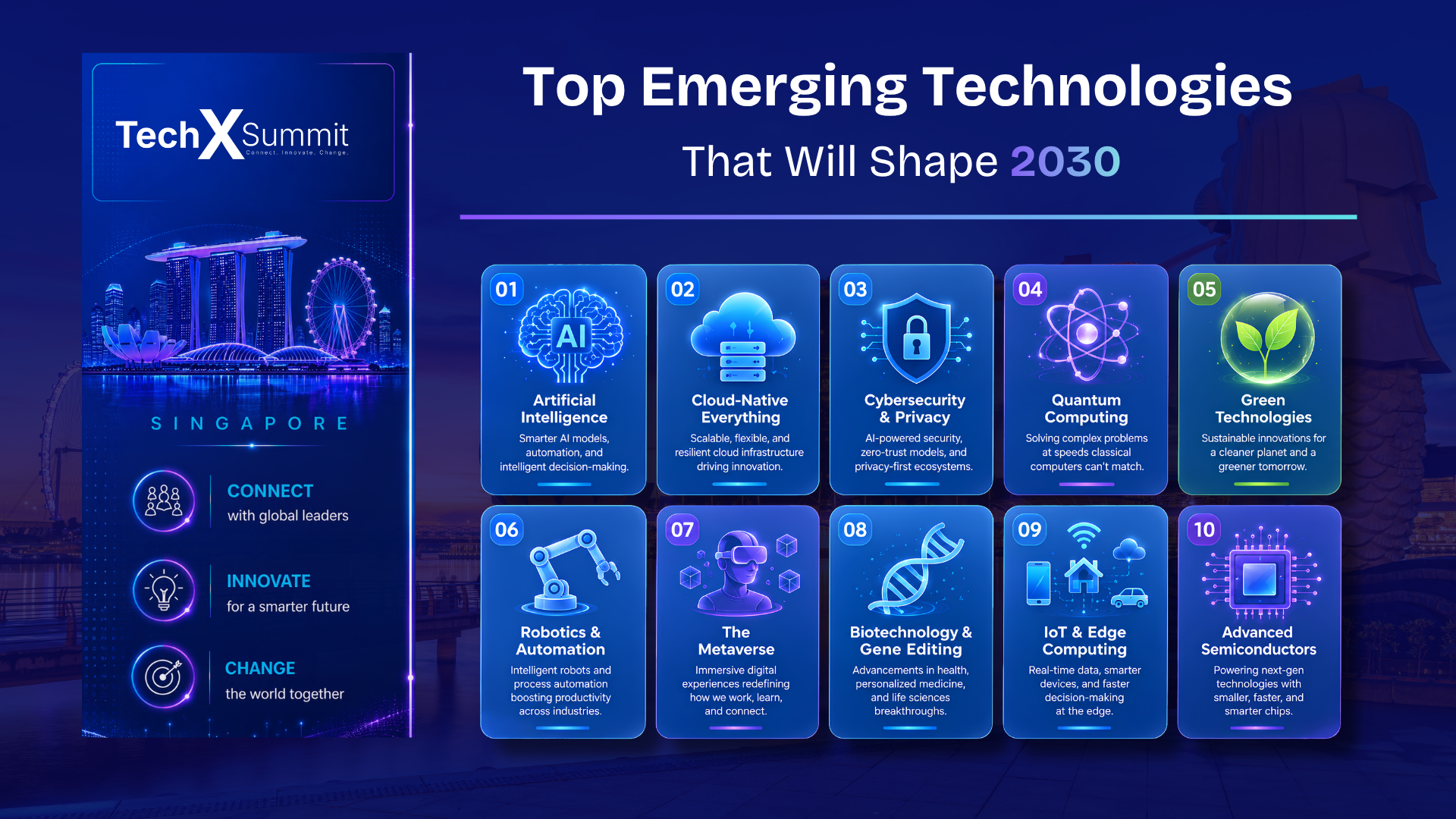
The 2020s have been defined by rapid acceleration in technology. By 2030, the convergence of multiple exponential technologies will create a fundamentally different world. Organizations and leaders who understand these shifts today will lead tomorrow’s economy.
1. Artificial Intelligence (AI)
Artificial Intelligence continues to redefine industries by enabling smarter decision-making, automation, and predictive insights. By 2030, AI-powered assistants, autonomous agents, and multimodal models will become essential across healthcare, finance, education, manufacturing, and government.
Organizations that embrace AI responsibly will gain a significant competitive advantage through faster innovation, improved productivity, and enhanced customer experiences.
2. Cloud-Native Everything
Cloud-native technologies are transforming how businesses build, deploy, and scale applications. With microservices, containers, Kubernetes, and serverless computing, organizations can innovate faster while reducing infrastructure costs.
As digital transformation accelerates, cloud-native architecture will become the foundation of modern enterprises, supporting resilience, agility, and continuous innovation.
3. Cybersecurity & Privacy
As cyber threats become increasingly sophisticated, cybersecurity is evolving beyond traditional defense. AI-powered threat detection, Zero Trust security, identity protection, and privacy-first frameworks are becoming essential.
Businesses investing in cyber resilience today will be better prepared to protect critical data, maintain trust, and ensure regulatory compliance in the AI era.
4. Quantum Computing
Quantum computing promises to solve highly complex problems beyond the capabilities of classical computers. Industries such as pharmaceuticals, finance, logistics, and materials science will benefit from unprecedented computational power.
As quantum technology matures, organizations must also prepare for the transition to post-quantum cryptography to secure future digital infrastructure.
5. Green Technologies
Green technologies are driving the transition toward a more sustainable future. Renewable energy, carbon capture, smart grids, and energy-efficient systems are helping industries reduce emissions while improving operational efficiency.
Innovation in climate technology will play a vital role in achieving global sustainability goals and creating resilient economies.
6. Robotics & Automation
AI-powered robotics and intelligent automation are revolutionizing manufacturing, logistics, healthcare, agriculture, and retail. Robots are taking on repetitive and high-risk tasks with greater speed and precision.
The future workforce will increasingly combine human creativity with robotic efficiency to improve productivity and operational excellence.
7. The Metaverse
The Metaverse is creating immersive digital environments where people can collaborate, learn, shop, and socialize using virtual and augmented reality technologies.
Powered by AI, spatial computing, and digital twins, the Metaverse is expected to unlock new opportunities for businesses, education, entertainment, and remote work.
8. Biotechnology & Gene Editing
Advancements in biotechnology and gene editing are transforming healthcare through personalized medicine, disease prevention, and precision therapies. Technologies like CRISPR continue to push the boundaries of medical science.
Beyond healthcare, biotechnology is enabling sustainable agriculture, bio-manufacturing, and innovative environmental solutions.
9. IoT & Edge Computing
IoT and Edge Computing enable connected devices to process data closer to where it is generated, reducing latency and improving real-time decision-making.
From smart cities and industrial automation to connected healthcare and autonomous vehicles, edge intelligence is becoming a key pillar of digital transformation.
10. Advanced Semiconductors
Advanced semiconductors power the next generation of AI, cloud computing, robotics, autonomous vehicles, and high-performance computing. Modern chip architectures are delivering faster performance with greater energy efficiency.
As demand for AI workloads continues to grow, innovations in semiconductor manufacturing, chiplets, and AI accelerators will shape the future of global technology leadership.
"The technologies shaping tomorrow are no longer distant possibilities—they are becoming today's competitive advantage. Organizations that embrace innovation today will lead the digital economy of 2030."
— Tech X Summit Editorial Team, 2026
Key Technologies to Watch by 2030
- AGI systems that act as autonomous research partners
- Fault-tolerant quantum computers solving real-world problems
- Widespread adoption of brain-computer interfaces
- Synthetic biology reshaping manufacturing and medicine
- Commercial fusion and advanced climate restoration tech
- Converged spatial computing and 6G infrastructure
Conclusion
The decade ahead will be defined by convergence. AI won’t operate in isolation — it will amplify quantum computing, biotechnology, robotics, and energy breakthroughs. Organizations that build future-ready capabilities today — strong digital talent, adaptive culture, robust data foundations, and ethical governance — will be best positioned to harness these technologies responsibly and create lasting value. Tech X Summit Singapore 2026 is the premier platform to hear directly from the pioneers driving these breakthroughs.
