

Vikneswaran Kunasegaran Takes the Stage at Tech X Summit Global 2026, Singapore as a Featured Speaker
Strengthening the future of cybersecurity through enterprise security, threat intelligence, resilience, and strategic leadership. Ts. Vikneswaran Kunasegaran, Senior Vice President – Enterprise Security at FIRMUS, brings 14+ years of cyber resilience expertise to Tech X Summit Global 2026 in Singapore.
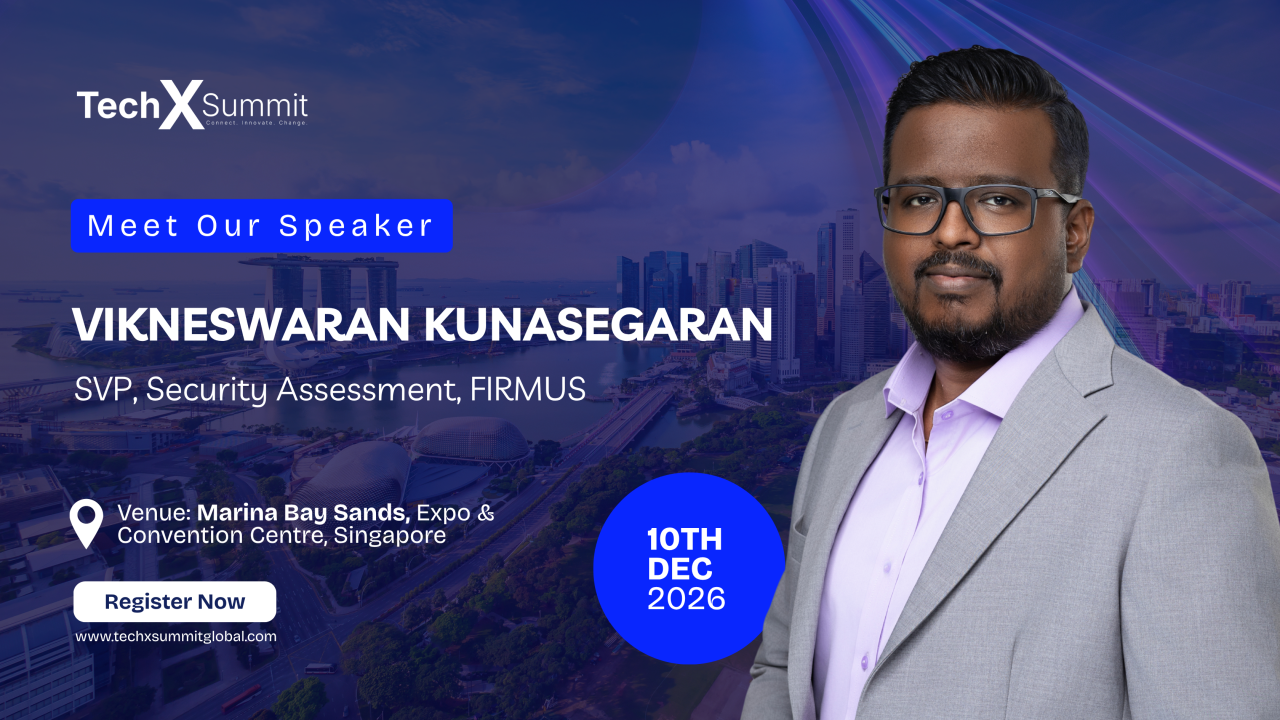
As organisations accelerate digital transformation, the cybersecurity landscape is becoming more complex than ever. Cloud adoption, artificial intelligence, connected systems, digital platforms, remote work, expanding attack surfaces, and increasingly sophisticated cyber threats are changing the way organisations think about security. Cybersecurity is no longer simply an IT function — it has become a fundamental component of business resilience, operational continuity, customer trust, regulatory readiness, and strategic leadership. Against this evolving backdrop, we are proud to welcome Ts. Vikneswaran Kunasegaran, Senior Vice President – Enterprise Security at FIRMUS, as a Featured Speaker at Tech X Summit Global 2026, taking place on 10 December 2026 in Singapore.
With more than 14 years of progressive experience in cybersecurity, Vikneswaran brings a strong combination of technical expertise, security leadership, consulting experience, and industry advocacy to the summit. His professional journey spans vulnerability management, penetration testing, compromise assessment, red teaming, threat hunting, incident response, security consulting, and enterprise security leadership. His participation will add an important cybersecurity perspective to conversations around AI, digital transformation, cyber resilience, enterprise security, emerging threats, risk management, and the future of trusted digital ecosystems.
Leading the Evolution of Enterprise Cybersecurity
Modern organisations operate in an environment where technology is constantly evolving. Every new digital capability can create new opportunities — but it can also introduce new risks. Cloud infrastructure, APIs, mobile applications, connected devices, third-party platforms, remote access, digital identities, and AI-powered systems have expanded the potential attack surface for organisations across industries.
This has fundamentally changed the role of cybersecurity professionals. Security teams are no longer focused only on protecting networks. They must understand applications, infrastructure, people, processes, data, business operations, and emerging technologies. Vikneswaran's career reflects this evolution. Through his work at FIRMUS, he has developed extensive experience helping organisations assess their security posture, identify vulnerabilities, understand potential attack paths, and strengthen their overall resilience.
His expertise demonstrates an important principle of modern cybersecurity: Security is not a one-time project. It is an ongoing organisational capability.
From Technical Security to Strategic Leadership
Ts. Vikneswaran Kunasegaran's professional journey demonstrates the evolution of a cybersecurity practitioner into an enterprise security leader. His experience includes:
- Penetration Testing
- Vulnerability Management
- Security Assessments
- Compromise Assessments
- Red Teaming
- Threat Hunting
- Incident Response
- Security Consulting
- Security Architecture
- Patch Management
- Network Security
- Security Awareness
- Cybersecurity Strategy
- Enterprise Security
- Cyber Resilience
- Risk Management
- Security Leadership
This combination of technical and strategic experience allows him to approach cybersecurity from multiple perspectives. A strong security programme is not simply about identifying vulnerabilities — it is about understanding which vulnerabilities matter most, how they could affect business operations, how quickly an organisation can respond, and how effectively it can recover.
The Importance of Vulnerability Management
Vulnerability management remains one of the foundations of effective cybersecurity. Every organisation has weaknesses. Some may exist in software. Others may exist in infrastructure, configurations, applications, cloud environments, processes, or human behaviour. The challenge is not simply finding vulnerabilities — the challenge is prioritising them intelligently. Organisations need to understand:
- Which vulnerabilities create the greatest business risk?
- Which systems are most critical?
- Which weaknesses can be exploited?
- How quickly should they be addressed?
- What happens if an attacker successfully exploits them?
Effective vulnerability management therefore requires more than technical scanning. It requires context, intelligence, prioritisation, and action. Vikneswaran's extensive experience in vulnerability management and security assessments reflects the importance of building proactive security programmes that identify weaknesses before attackers can exploit them.
Penetration Testing: Thinking Like an Attacker
One of the most important aspects of cybersecurity is understanding how attackers think. Penetration testing provides organisations with an opportunity to simulate real-world attack techniques and identify weaknesses before they are exploited. Vikneswaran has built significant expertise in penetration testing and is a GIAC Penetration Tester (GPEN). His cybersecurity journey has included vulnerability assessment, penetration testing, red teaming, compromise assessment, and other security testing activities.
The objective is not simply to produce a technical report. The real objective is to answer a much more important question: "If an attacker targeted us today, how far could they go?" Understanding this question can help organisations strengthen security controls, improve detection capabilities, close vulnerabilities, and prepare teams for realistic attack scenarios.
Red Teaming & Adversarial Security
As cyber threats become increasingly sophisticated, organisations need to move beyond traditional security testing. Red teaming provides a more adversarial approach. Instead of simply checking whether individual vulnerabilities exist, security professionals can simulate realistic attack scenarios and test how an organisation's people, technology, processes, and security controls respond. This can reveal weaknesses that traditional assessments may not always identify.
For enterprise leaders, red teaming can provide valuable insights into:
- Attack paths
- Security control effectiveness
- Detection capabilities
- Response readiness
- Human vulnerabilities
- Communication gaps
- Operational weaknesses
- Incident response processes
It ultimately helps organisations move from theoretical security to real-world resilience.
From Detection to Prevention
The cybersecurity industry is also experiencing a major shift. For many years, organisations focused heavily on detecting threats after suspicious activity occurred. But modern cybersecurity increasingly requires organisations to become proactive. Instead of asking: "How quickly can we detect an attack?" security leaders must also ask: "How can we prevent the attack from succeeding in the first place?"
This requires combining intelligence, vulnerability management, threat hunting, security testing, employee awareness, monitoring, incident readiness, and continuous improvement. Vikneswaran has actively contributed to industry discussions around moving from detection towards prevention and strengthening cybersecurity readiness against evolving threats.
"Security is not a one-time project. It is an ongoing organisational capability."
— Ts. Vikneswaran Kunasegaran, Featured Speaker, Tech X Summit Global 2026
Threat Hunting & Incident Response
No organisation can assume that it will never experience a cyber incident. The more realistic approach is to prepare for the possibility. Threat hunting helps organisations proactively search for suspicious activity that may not immediately trigger conventional security alerts. Incident response, meanwhile, determines how effectively an organisation can react when something goes wrong. Strong incident response requires:
- Clear roles and responsibilities
- Defined communication channels
- Technical expertise
- Rapid investigation
- Containment procedures
- Evidence preservation
- Recovery planning
- Post-incident analysis
The difference between a manageable incident and a major business disruption can often come down to how prepared an organisation was before the incident occurred. Vikneswaran's experience in compromise assessments, threat hunting, and incident response reflects the growing importance of preparedness and resilience in enterprise cybersecurity.
AI Is Changing the Cybersecurity Battlefield
Artificial intelligence is creating both opportunities and challenges for cybersecurity. Security teams can potentially use AI to analyse large volumes of data, identify patterns, detect anomalies, accelerate investigations, and support security operations. At the same time, attackers can also use AI to increase the speed and sophistication of their activities.
This creates a new cybersecurity reality: AI can strengthen both the defenders and the attackers. Organisations therefore need to think carefully about how AI is introduced into their security strategies. The question is not simply: "How can we use AI for cybersecurity?" It is also: "How do we secure AI itself?"
Securing the AI Era
As organisations deploy generative AI, AI agents, machine-learning systems, and intelligent applications, a new category of security considerations is emerging. Organisations need to think about:
- Data exposure
- Model security
- Access controls
- Prompt-based attacks
- AI supply-chain risks
- Privacy
- Model misuse
- Shadow AI
- Identity management
- Governance
- Human oversight
AI systems are becoming part of business operations. Therefore, securing AI cannot remain the responsibility of only AI developers. It requires collaboration between technology leaders, cybersecurity teams, business executives, risk professionals, and governance functions.
Cyber Resilience in a Connected World
Digital transformation has created highly connected organisations. But connectivity also creates dependency. A disruption to one system can potentially affect multiple business functions. This is why cybersecurity is increasingly connected to business continuity and organisational resilience. Cyber resilience is not simply about preventing attacks — it is about ensuring that an organisation can: Prepare → Prevent → Detect → Respond → Recover → Learn.
This approach recognises that security incidents can happen even in mature organisations. What matters is how quickly and effectively the organisation can respond.
The Human Layer of Cybersecurity
Technology is only one part of cybersecurity. People remain one of the most important components of an organisation's security posture. Employees interact with systems, applications, emails, data, devices, and external parties every day. A strong security strategy therefore needs to include:
- Security awareness
- Employee education
- Phishing awareness
- Strong authentication
- Access management
- Security culture
- Leadership accountability
Vikneswaran's experience also includes security awareness and competence initiatives, reinforcing the importance of strengthening the human layer of information security.
Building Security Into Business Strategy
One of the biggest changes in cybersecurity leadership is the growing relationship between security and business strategy. Cybersecurity leaders increasingly need to communicate with boards, executives, business leaders, regulators, customers, and technology teams. Security decisions can influence:
- Business continuity
- Customer trust
- Regulatory compliance
- Financial performance
- Brand reputation
- Digital transformation
- Investment decisions
This means cybersecurity can no longer operate in isolation. It needs to become part of the organisation's broader strategic conversation.
Strengthening Cybersecurity Across Asia
Cyber threats do not respect borders. As organisations expand across Asia and global markets, their cybersecurity challenges also become increasingly interconnected. Threat actors can operate across jurisdictions. Supply chains can span multiple countries. Cloud infrastructure can be distributed globally. Customers can access services from anywhere. This makes regional collaboration increasingly important.
Vikneswaran's involvement with CREST's Asia Council reflects his contribution to broader cybersecurity capability and professional development across the region. CREST lists him among its Asia Council members for the 2025–2028 term.
Industry Leadership & Knowledge Sharing
Cybersecurity leadership extends beyond an individual's organisation. Sharing knowledge, mentoring professionals, participating in industry discussions, and contributing to cybersecurity communities are important components of building a stronger security ecosystem. Vikneswaran has been active as a cybersecurity speaker and industry participant, contributing to conferences, panels, awareness initiatives, and professional discussions. His journey reflects the importance of combining technical knowledge with continuous learning and knowledge sharing.
Speaking at Tech X Summit Global 2026, Singapore
At Tech X Summit Global 2026, Ts. Vikneswaran Kunasegaran will bring his cybersecurity expertise to a global audience of technology leaders, business executives, founders, investors, innovators, and industry professionals. His perspective can contribute to important conversations around:
- Enterprise Cybersecurity
- Cyber Resilience
- Threat Intelligence
- Penetration Testing
- Vulnerability Management
- Red Teaming
- Threat Hunting
- Incident Response
- AI & Cybersecurity
- Digital Risk
- Security Strategy
- Security Awareness
- Enterprise Risk Management
- Future Cyber Threats
- Building Trusted Digital Ecosystems
As businesses continue to accelerate digital transformation, these conversations have become more important than ever.
Tech X Summit Global 2026: Where Technology Leaders Connect
Tech X Summit Global 2026 is bringing together global technology leaders, founders, investors, innovators, policymakers, researchers, and industry experts to explore the technologies shaping the next generation of business. The summit will provide a platform to discuss:
- Artificial Intelligence
- Cybersecurity
- Fintech
- Cloud Technology
- SaaS
- Blockchain
- Data & Analytics
- Robotics
- Digital Transformation
- Emerging Technologies
- Future of Work
- Technology Leadership
The event will also create opportunities for meaningful networking, knowledge exchange, collaboration, business relationships, and cross-industry conversations. 10 December 2026 — Marina Bay Sands Expo & Convention Centre, Singapore
Key Takeaways: Vikneswaran at Tech X Summit Global 2026
- Cybersecurity has evolved from IT function to strategic business enabler — security leaders now communicate with boards, executives, regulators, and customers, not just technical teams.
- Modern cybersecurity demands multiple disciplines working together — vulnerability management, pen testing, red teaming, threat hunting, incident response, and security architecture must operate as one organisational capability, not silos.
- AI changes the cybersecurity battlefield in both directions — defenders can use AI to detect and respond faster, but attackers can use AI to accelerate and sophisticate their activities. Securing AI itself becomes a new discipline.
- Cyber resilience > cyber prevention — mature organisations assume incidents will happen and focus on Prepare → Prevent → Detect → Respond → Recover → Learn, not just prevention alone.
- The human layer remains the most important — security awareness, phishing training, strong authentication, and security culture matter as much as technical controls. Technology alone cannot secure an organisation.
Conclusion
The future of cybersecurity will not be defined by one technology, one security product, or one security team. It will be defined by how effectively organisations combine Technology + People + Intelligence + Strategy + Resilience. As AI and digital transformation continue to accelerate, organisations will face increasingly sophisticated cyber risks. The businesses that succeed will be those that understand cybersecurity not as a barrier to innovation, but as an enabler of trusted innovation. Security creates confidence. Resilience creates continuity. And trust creates the foundation for sustainable digital growth. Vikneswaran Kunasegaran's professional journey reflects this evolving approach to cybersecurity leadership — combining technical depth, enterprise security, industry engagement, and a commitment to helping organisations prepare for an increasingly complex threat landscape. We are honoured to welcome Ts. Vikneswaran Kunasegaran to Tech X Summit Global 2026, where he will contribute his perspective on enterprise security, cyber resilience, emerging threats, AI, and the future of cybersecurity. The future of cybersecurity is not about asking whether an organisation will face a threat — it is about asking how prepared the organisation will be when that threat arrives.
