

The Next Wave of Digital Payments: AI, Blockchain, and Beyond
Smarter. Faster. Safer. The future of payments is here. Explore how AI, blockchain, and digital payment technologies are transforming financial services with faster, more secure transactions, smarter automation, and seamless customer experiences.
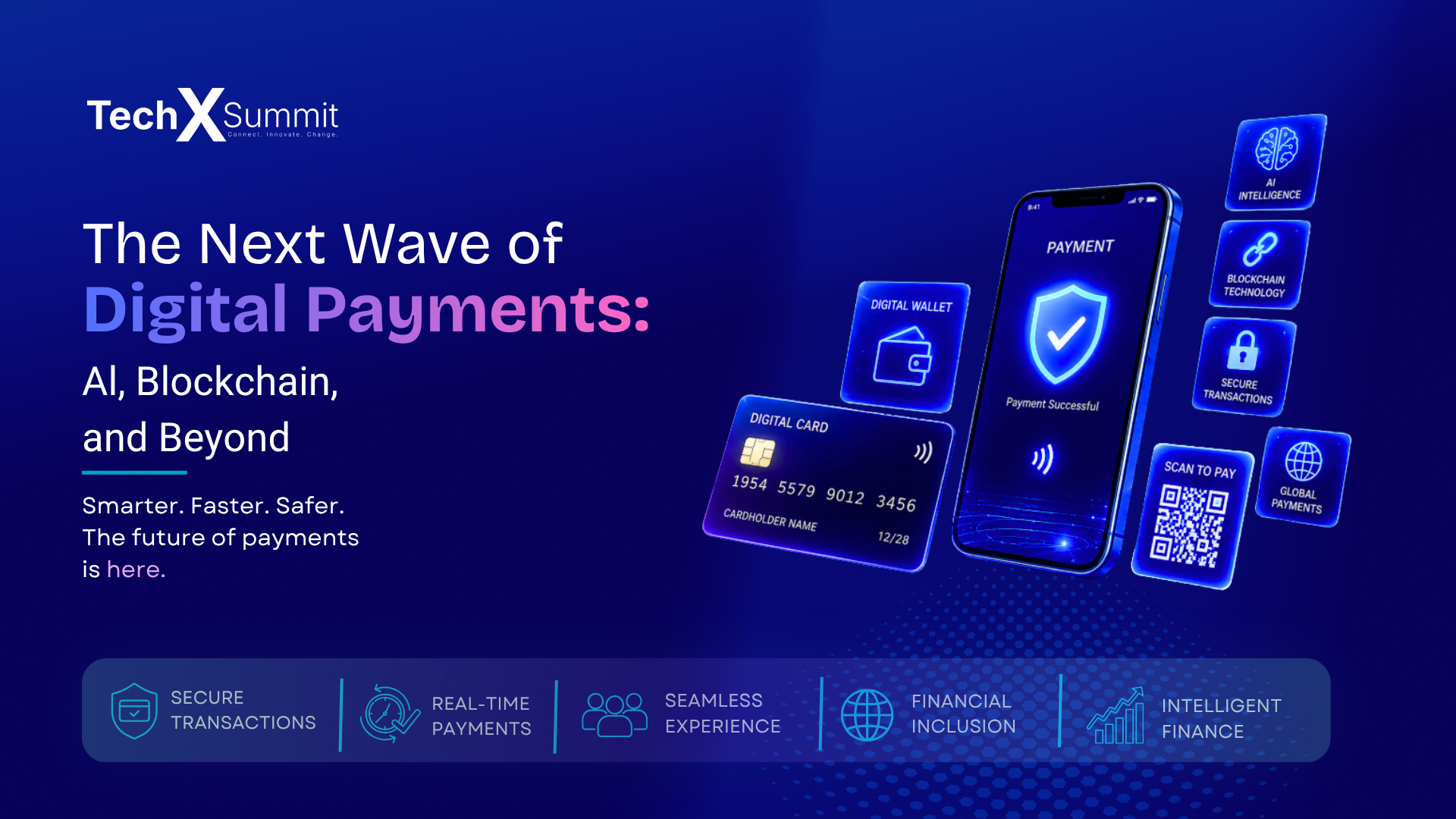
Money has always moved with the technology of its time — from coins to cheques to cards. Today, that movement is being redefined again. Artificial intelligence and blockchain are converging with digital payment infrastructure to create a financial system that is faster, safer, and far more intelligent than anything that came before it. The next wave of payments isn't just about moving money digitally — it's about moving it smartly.
Why Payments Are Being Reinvented Again
Traditional payment rails were built for a world of batch processing and business-hours settlement. Today's consumers and businesses expect instant, always-on transactions — across borders, currencies, and channels. Legacy infrastructure simply wasn't designed for that pace, which has opened the door for AI and blockchain to redefine what a payment system can do.
This isn't a single breakthrough — it's the convergence of several forces: smarter fraud detection, programmable money, real-time settlement, and payment experiences that adapt to the user rather than the other way around.
1. AI-Powered Fraud Detection and Risk Scoring
Machine learning models now analyze transaction patterns in milliseconds, flagging anomalies that would be invisible to rule-based systems. By learning what "normal" looks like for each individual account, AI can catch subtle fraud signals — an unusual purchase sequence, a mismatched device fingerprint, a location inconsistency — without slowing down legitimate transactions.
This shift from static rules to adaptive, self-learning risk models is one of the biggest reasons digital payment fraud rates have started declining even as transaction volumes soar.
2. Blockchain: Trust Without a Middleman
Blockchain technology enables payments to settle directly between parties, recorded on a shared, tamper-resistant ledger. This removes the need for multiple intermediary banks in cross-border transfers, cutting both cost and settlement time from days to seconds in many cases.
Beyond speed, blockchain's transparency creates an auditable trail for every transaction — valuable for compliance, dispute resolution, and building trust in markets where traditional banking infrastructure is limited or unreliable.
3. Smart Contracts and Programmable Money
Smart contracts allow payments to execute automatically once predefined conditions are met — a supplier gets paid the moment goods are confirmed delivered, or an insurance payout triggers automatically when a verified event occurs. This turns payments from a manual step into a programmable, conditional part of a broader business process.
- Automated supplier and vendor payments tied to delivery confirmation
- Escrow-free marketplace transactions with built-in dispute logic
- Usage-based billing that settles instantly as services are consumed
- Cross-border payroll that converts and settles in local currency automatically
4. Real-Time, Cross-Border Settlement
Combining AI-driven currency routing with blockchain settlement rails, modern payment networks can move funds across borders in seconds rather than days, at a fraction of traditional correspondent-banking costs. This is reshaping global commerce for small businesses and gig workers who previously absorbed high fees and long delays just to get paid internationally.
"The future of payments isn't just digital — it's intelligent, instant, and increasingly invisible, woven directly into the moment a transaction needs to happen."
— Tech X Summit Editorial Team, 2026
5. Biometric and Frictionless Authentication
Passwords and PINs are steadily giving way to biometric authentication — facial recognition, fingerprint verification, and behavioral biometrics that continuously validate identity based on how a person types, taps, or holds their device. AI models power this shift by learning individual behavioral patterns and flagging deviations in real time, making authentication both faster and more secure.
6. Central Bank Digital Currencies and Stablecoins
Central banks around the world are piloting digital currencies designed to combine the stability of fiat money with the efficiency of blockchain-based settlement. Alongside them, private stablecoins are increasingly used for cross-border trade and remittances, offering price stability without the volatility associated with other digital assets.
7. Personalized, AI-Driven Financial Experiences
Beyond moving money, AI is reshaping how payment experiences feel to the end user — offering personalized spending insights, predictive cash-flow alerts for small businesses, and dynamic checkout experiences that adapt payment methods and offers to individual customer behavior in real time.
Challenges to Navigate
This transformation isn't without friction. Regulatory frameworks are still catching up to programmable money and blockchain-based settlement across jurisdictions. Interoperability between competing blockchain networks and legacy banking rails remains a technical hurdle. And as fraud detection gets smarter, so do the fraud attempts themselves, requiring continuous model retraining and vigilance.
Institutions that succeed will be the ones that treat security, compliance, and customer trust as design requirements from day one — not features bolted on after launch.
Key Takeaways: The Next Wave of Digital Payments
- AI-driven fraud detection adapts in real time, catching threats static rules miss
- Blockchain enables faster, cheaper, more transparent cross-border settlement
- Smart contracts turn payments into automated, condition-based actions
- Biometric authentication is replacing passwords for faster, safer verification
- CBDCs and stablecoins are reshaping how value moves across borders
- Regulation and interoperability remain the biggest hurdles to widespread adoption
Conclusion
The next wave of digital payments is being written at the intersection of AI, blockchain, and real-time infrastructure. Institutions that embrace this convergence — building smarter, more secure, more transparent payment systems — will define the customer experience of the next decade. Tech X Summit Singapore 2026 brings together the fintech leaders and innovators shaping this future. Join us to explore what's next for money, movement, and trust.
